January 29, 2010

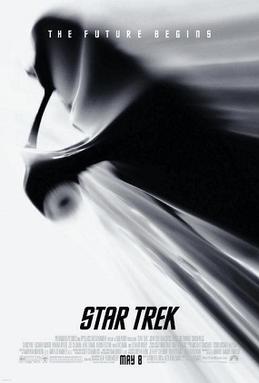
Star Trek (2009)

I guess I should start with a warning that I watched this movie without immense amounts of Star Trek knowledge. In fact, a large amount of my Star Trek knowledge comes from an episode of Futurama. I think I've seen a part of an episode or two but never a movie. And somehow in my life I became familiar with phrases like "I'm giving her all she's got, Captain." and "Dammit, man! I'm a doctor, not a physicist!" Add to that the facts that director J. J. Abrams said this was made so anyone could watch it regardless of Star Trek background, and writer Roberto Orci has mentioned Star Wars influence and I couldn't help but be curious.

Ironically in a feature on the DVD, they discuss that they felt Star Trek was always like classical music while Star Wars was rock and roll and they wanted to bring some of that rock and roll to this film. Abrams specifically cites that he felt the Star Wars: Empire Strikes Back pace was what modern audiences needed.

So that makes it very interesting that the movie has such a stunted start. While it provides background on some of our main characters, most of it is also relayed later through dialogue that does just fine letting us know what we need to know. So instead of editing that early stuff out, it jarringly skips to a few minutes of one character's life here and another's there. Before you know it, it feels like five false starts and we're already nearly fifty minutes in before the film really gets going. The pacing gets better but the injections of comedy soon fade away and we're thrown into summer blockbuster-style action and it's just not quite as fun.

There are some great filmmaking techniques at play here though. Abrams actually followed the camera around tapping on it and shaking it to get a more organic shudder to action sequences. It's one of those things that you don't give much thought to but really helps make a sequence. ILM did the CGI work on this film and they actually had to find a way to replicate that shaking for consistency. They ended up putting a motion sensor on their desks and tapping it like Abrams did and voila... seamless style.

Abrams also hired kids to walk and run through certain sets to make them seem bigger than there were. It's a pretty brilliant shortcut to saving materials. In another sequence the characters are supposed to be quickly falling down towards a planet's surface so instead of hanging them upside down on wires, the production team built a platform and shot down at the actors standing on mirrors. The mirrors reflect the sky, it really looks like they're falling on film, and no one had to have all their blood rush to their head.

It's this kind of innovation and creativity that makes me curious as to what Abrams and his team have up their sleeve next. This effort was cooled by a story that could have used some more editing and more of a challenge for the characters. It was fun to watch and the acting was fine, but it wasn't anything fantastic.

Rating: 3/5
Recommended for: if you're bored and you like space but you're not a scientist

January 17, 2010

Avatar (2009)

James Cameron revived himself to bring us another movie people will see in theaters six times each, supplementing his bank account for another twelve years. This time it's Avatar, a really pretty video game complete with abrupt dialogue, running, and plenty of weaponry.

The concept is Jake Sully (Sam Worthington), a paraplegic ex-marine, is taking his dead twin brother's place, in an operation focused on mining the ridiculously-name unobtanium on the planet Pandora. He's now part of a scientific team lead by Dr. Grace Augustine (Sigourney Weaver) which uses avatars of the native population, the Navi, to learn about them and the biology of their planet.

Jake becomes the driver of his brother's avatar and the aforementioned running ensues. While the concept is complex, the story beyond that is practically nonexistent. And what is there feels very recycled. Some have been saying it's Fern Gully, Pocohantas, and Dances with Wolves rolled in one. I'm inclined to agree.

Luckily the actors bring serious gravitas to some ridiculous dialogue. They try their best to make lines that are clearly there just to inform the audience or to hit you over the head with a message seem like something their character might naturally say.

This movie's strongpoint is definitely its visuals. Cameron and his team have made advancements in CGI but since the focus was definitely on that, I couldn't help but be reminded a bit of The Phantom Menace fiasco. And many of the vehicles created look like they've been lifted from the Halo series as well as other video games (although one vehicle is clearly a retooled piece from Aliens). On top of the CGI though, Team Cameron uses 3D to their advantage. There were no cheap "Hey, look this thing is pointing at/reaching out to get you." shots.

Part of the problem with 3D in this movie (and probably others to come) is that like any other live action film, selective focus is used. While this technique is employed to draw your attention to a specific place in a scene, in 3D the issue comes up where something appears physically closer to you but is out of focus. Sometimes the out of focus item isn't closer to you but since it still pops out from the background, it can still be distracting. And that messes with your brain. The headache the whole thing gave me eventually passed as my eyes were worn down and beaten into submission.

Avatar runs nearly 3 hours. It appears since Cameron was also the editor (in addition to the director/producer/writer), there was very little left on the digital cutting room floor. When you see a slow-motion screaming/running/things exploding sequence, don't be surprised when yet another one comes five minutes later. If you didn't get enough of a soaring sequence, don't worry you'll get another one soon enough.

Rating: 3/5
Recommended for: People who enjoy the color blue and small children with long attention spans.

Extended Review: Dr. Augustine's group goes through all the trouble of growing these incredibly expensive Navi avatars so they can infiltrate the native population. And yet, the avatars wear human clothing which looks nothing like the very distinct Navi garments. It seems like a lot of trouble to go through just to announce that you're not really one of them without even saying a word. The Navi are quite large (about twice as big as humans) so I guess it'd take longer to walk through the forest if you weren't using your avatar. Also, I guess this way the humans can talk to the Navi eye-to-eye. But there seems to be no reasoning behind making the Navi so tall except to and yet another element of different-ness. When the humans and Navi are in the same scene, it just looks ridiculous.

January 1, 2010

District 9 (2009)

District 9 is not only a sci-fi movie; it's a smart movie. And it's intense - really really intense. Around ten minutes in it grabs you and won't let go, building momentum along the way until it's time to roll credits.

In the film, twenty-some years ago a massive alien ship stopped over Johannesburg, South Africa. An exploratory team found many unhealthy extraterrestrials inside and brought them down to live in a camp - District 9. Eventually it's a highly-secured slum and several "prawns" (as they're sometimes called derogatorily) are involved in violent protests and crimes.

So in 2010 Multinational United (MNU) is contracted to relocate the aliens to District 10, 200 km outside the city. In documentary style, the audience follows Wikus Van De Merwe (Sharlto Copely), a bureaucrat on the team serving eviction notices. After an accident, Van De Merwe learns what it's like to be on the other side of MNU's armored vehicles. Don't let what happens to Van De Merwe turn you off, and you'll be glad you stayed.

We get to see the district through a blend of filming styles that also includes security camera footage and traditional Hollywood style filming. Eventually it totally gives way completely to that last style. That transition is just one of the many smooth, thought-out aspects from Neill Blomkamp and his team in this movie. This is not mindless entertainment.

There is never just action for action's sake. There are motion-capture CGI aliens and violent explosions but they are used sparingly. It's clear the film isn't about how well they can make alien special effects - it's about the story. But the sparse use also helps make it all seem more realistic. There's this gritty, dirty feel to the whole thing. The production filmed in an impoverished neighborhood where residents had actually been relocated to a government-run housing district.

District 9 deals with many of the same issues in South Africa during the Apartheid - such as racism (rather speciesism here) and forced relocation. The treatment of refugees is another embedded element. These layers are woven in thanks to Blomkamp's own experience growing up in South Africa, but it's not a parable. You could be entertained by this film without knowing about the history in which it's entrenched.

Neil Blomkamp had the opportunity of a lifetime in making this movie. It was his first time directing a feature-length film and Peter Jackson as his producer just let him run with it. The finished product is fantastically made and very interesting to see.

Rating: 4/5
Recommended for: Those who don't mind a shot of world history with their sci-fi
(not recommended for small children)

THX 1138 (1971)

Before the incredibly well-known Star Wars series, George Lucas made THX 1138. Based on a short-film he'd made in college, THX 1138 is set in the 25th century in a strict underground society where daily sedative consumption is required and everyone has been assigned a function. Cameras and computers monitor every move. It's not too far outside the vein of books like The Giver or 1984.

When THX 1138 and his roommate LUH 3417 stop taking their medication, they start to have feelings - like attraction. This new awakening leads to actions that throw them in the spotlight, where they are deemed unfit for regular existence and arrested.

It's difficult to say too much more without giving the whole story away because there's not too much more of the story. In fact, throughout the film it feels like you're circling outside a story, never really getting into details or why things are the way they are, just hanging in space as things happen in front of you. It's borderline trippy.

Weirdly enough, it sort of works. The vague, lost quality of it all lets the audience feel what it's like to live in THX's society. Also, it's very apt for Lucas, who's known for only speaking minimally to his actors while directing. He's always seemed to have a strong vision for his films but not always the best success of fully sharing it with everyone else. Here the visuals do a lot of the speaking for him.

Time spent in quiet, all white, endless rooms contrasts with that spent in loud, crowded, grittier transportation areas. In fact those transportation areas are the most fantastic of the visual sequences. They seem to be paving the way for running down the trenches of the Death Star in Star Wars: A New Hope. In reality it was clever use of places like the San Francisco International Airport, Caldecott Tunnel, and the (at the time) unfinished BART subway system.

Robert Duvall also helps with his commitment to the character of THX 1138. Without saying much, he's easy to latch onto and take seriously.

This movie might not be for those who thrive on a great story, but it's definitely something different than what you can see any given day.

Rating: 3/5
Recommended for: Adults who'd like to see pre-stormtroopers

December 29, 2009

Strangers On A Train (1951)

Lonely socialite Bruno Anthony (Robert Walker) meets rising amateur tennis star Guy Haines (Farley Granger) on a train out of Washington DC. Through casual conversation Bruno reveals his theory on how two strangers could get away with murder as well as how he's noticed both him and Guy have someone in their lives they could do without.

Strangers On A Train is #32 on the American Film Institute's 100 Years... 100 Thrills list. And while it was directed by Alfred Hitchcock, it's really the plot that makes the film a classic. It's so classic the concept has been used on every television crime show. In fact, it's pretty easy to be familiar with this movie without ever having seen it.

The film itself though is not all together timeless. Many elements that worked just fine in the 50s come across as corny today, making it harder to come by character buy-in. One such corny element is the blatant attempts to make two female characters, Miriam and Barbara, look dowdier than the romantic lead through the use of incredibly thick glasses. While the glasses also serve another purpose, they practically yell out how you're supposed to feel and think about these two women. In other words, subtlety is lost on this film. Another incident involves an out-of-control carousel, which raises too many credibility questions and almost ruins a tense moment with its ridiculousness.

But even with the film's datedness, there are still enduring Hitchcock facets. One is his patented slow chase. Much like in 1946's Notorious, there's a chase that includes a fair amount of waiting, sitting, and stopping but amazingly retains its urgency throughout. The tension Hitchcock creates there, and really through the last half of the film, is so well done - especially since the characters weren't so sympathetic to begin with.

Possibly the most timeless element of all though is Bruno's creepiness. Although this isn't so much to Hitchcock's credit as it is to Robert Walker's performance and the story itself.

Rating: 3/5
Recommended for: People who enjoy watching slow, shoddy police work

December 26, 2009

Julie & Julia (2009)

Julie & Julia is full of food, frustration, and more food. It slides back and forth between two stories. One is that of Julia Child (Meryl Streep) entertaining herself with cooking and eventually taking over the assembly of Mastering the Art of French Cooking in the 1950s. The other is Julie Powell (Amy Adams) blogging and cooking her way through every recipe in Mastering the Art of French Cooking in 2002.

The cookbook is the thin string tying the two plots together. One would think that maybe there should have been two movies instead of one, but the Julie Powell story doesn't seem to have enough meat to stand on its own. Plus, despite Amy Adams' best intentions and efforts, the character of Julie remains difficult to find sympathetic overall. The movie is actually based on a combination of Julie's book/blog and a book on Julia.

Meanwhile the Julia Child story felt like it could have been expanded into a rather interesting biopic. Streep's accent is just how I remember Child's from her cooking shows. And her story isn't one that's been told over and over. Not to mention it has more developed characters and a more solid conflict than the Julie story does.

Overall it's an entertaining enough film to give watching it a shot. At the very least you can admire all the techniques they employ to make Streep look as tall as the real 6" 2' Julia. We also have to give them props for at least mentioning eating recipes out of that cookbook on a daily basis can be hazardous to your digestive system.

Rating: 3/5
Recommended for: Julia Child enthusiasts, people who wonder what could happen to them if they became devoted to making all the Mastering the Art of French Cooking recipes, and/or those who miss Meg Ryan talking to her computer in You've Got Mail

(500) Days of Summer (2009)

I'm hesitant to put (500) Days of Summer in the category of romantic comedy because it's just not the same fare you typically get out of the genre. Yes, there's comedy. Yes, there's romance. It has its share of silly moments. But it's something loftier and smarter than How to Lose a Guy in 10 Days or You've Got Mail.

The film nonlinearly explores greeting-card-writer Tom Hansen's (Joseph Gordon-Levitt) love for co-worker Summer Finn (Zooey Deschanel) over the course of 500 days. The script is by first time screenwriters Michael Weber and Scott Neustadter. Titles pop up to let us know which day we're on and but it's really a tribute to editor Alan Edward Bell, director Marc Webb, and the two leads that the audience never gets left behind. Bell has already won the San Diego Film Critics Society Award for Best Editing and it won't be surprising if he gets an Oscar nomination as well.

Webb and Gordon-Levitt seem to make quite the formidable team as well in Webb's first feature-length film. While Webb has mainly been responsible for a few music videos for 3 Doors Down and Green Day, you may remember Gordon-Levitt as the long-haired kid on the tv show Third Rock from the Sun. He's come a long way, had a fairly consistent amount of work since then, and has no doubt made a successful transition from child to adult actor.

Here Gordon-Levitt is our well-developed driver, taking us on a tour of joy, confusion, and heart-break. Summer knows who she is, or at least claims to, and tells Tom right from the start she's not looking for a boyfriend. He embarks on a relationship with her anyway and the story is still captivating even knowing from the beginning the relationship doesn't have a good chance. This movie isn't conventional so we're allowed to still have some hope.

They even make a dance number and scenes in a karaoke bar charming, fresh, and fitting. Zooey Deschanel seems to be wearing all her own clothing and hair accessories, but it is an indie movie after all so I'm willing to write it off as a money saver.

Rating: 5/5
Recommended for: Anyone who has ever loved anyone to whom they weren't related

Extended Review:
A note about the soundtrack: Give this film's soundtrack a listen. It includes some classics that have made recent appearences elsewhere (Hall & Oates' You Make My Dreams Come True & The Smiths' Please, Please, Please Let Me Get What I Want,) some other songs that have been just waiting for a soundtrack inclusion (Regina Spektor's Us and Feist's Mushaboom) and an interesting inclusion (but obviously a shot at romance with French lyrics) of Quelqu'un m'a dit by French first lady, Carla Bruni.

December 11, 2009

Food, Inc. (2008/2009)

Food, Inc. is sometimes difficult to watch yet at the same time intensely interesting. The film takes a critical look at large-scale, industrial-style food production in the US.

It makes the assertions that current practices are environmentally unsustainable, unhealthy, and often inhumane. It introduces you to people whose lives have been affected by food prices as well as tainted food. And on the lighter side it reviews agricultural and food production practices it finds commendable. Producers of the film tried to give the film a bit more balance by giving companies criticized a chance to tell their side. But every one of them declined.

While many scenes will stick with you after viewing, one of the saddest was watching a young girl and her family grocery shop. They have a limited food budget because they have to pay a lot for the father's diabetes medications. The mother knows fast food is less healthy for her two daughters, but feels stuck because it's a cheaper way to fill their stomachs. Inside the supermarket the youngest daughter is reduced to tears when she asks to buy fruit and her older sister explains that they can't get enough pieces with the current price.

When is the last time you saw a child throw a tantrum in a grocery store over fruit? Not candy. Fruit.

I understand that there are a lot of people in the world to feed, but I also understand that technological advancements in food production played a part in allowing the population to expand. Food, Inc. has some suggestions on what an individual can do to support healthy food production, but it doesn't have a solid solution as to how to feed so many people when the current ways are seen by so many as efficient.

Most people don't know where their food came from or what happens on the way to their plates. So even if Food, Inc. doesn't have all the answers, it'll at least open your eyes to that process. Director Robert Kenner accomplishes that in a way that's visually striking and hard to forget.

Rating: 4.5/5
Recommended for: After you've just eaten a salad

Extended Review: If you see it on DVD, be sure to watch all the deleted scenes. There's some interesting stuff they cut for time reasons or what have you.

Coco Avant Chanel (2009)

Coco Avant Chanel is a French-language film about the life of world-famous fashion designer Gabrielle "Coco" Chanel before she was so famous. The story begins with her father dropping her and her sister off at an orphanage. From there it moves to her time working as a seamstress & entertainer to her living with millionaire Etienne Balsan and her hobby of wearing repossessed menswear and hat-making - the last bit being what helped push her into fashion.

Coco is played with great vigor by Audrey Tautou. As she scowls and trudges through Balsan's estate, you can see the beginnings of a designer who'll settle for nothing less than her own carefully constructed style. And when she finally smiles, it lights up her whole being and you see a woman who is truly passionate. While Tautou was lovable as Amelie, here she's admirable both as Chanel and as an actress who has clearly thought about the complexities of her character.

As good as she is, Tautou doesn't do it all on her own. She's given an interesting story to work with thanks to Coco herself as well as writers Anne and Camille Fontaine, who based their script (loosely I hear) on the book L'irregulaire by Edmonde Charles-Roux. Anne Fontaine directs as well, leading the rest of the cast into complimentary position around Tautou's Chanel and making everything float naturally into sequence. Meanwhile Catherine Leterrier's costumes provide the stage for Chanel's pieces to shine through the more complicated period costumes with simple beauty.

Instead of a common biography - how a woman turned into a fashion empire,we get the story of a woman who was who she was, worked hard and eventually the masses appreciated her work. And that leaves more hope for the rest of us.

Rating: 4/5
Recommended for: Those who realize the title is Coco Before Chanel

Changeling (2008)

Based on the true story of a single mother who is reunited with her formerly missing son, only to discover that he isn't actually her son, this story has all the drama you need in its arsenal. And if that wasn't enough, it stars Angelina Jolie as the mother, Christine Collins, John Malkovich as Rev. Gustav Briegleb, the man who tries to help Christine in her quest to be heard, and it's directed by Oscar-winning-director Clint Eastwood.

It was all actually a bit too much.

With the exception of Jeffrey Donovan's accent sliding, every performance in it was excellent. You can tell Jolie is a mother in real life, as she passionately searches for answers. Malkovich appears near-mad in his dedication. An almost unrecognizable Amy Ryan is absolutely gritty as a representative resident of a mental institution. Even the children in the film all do an almost horrifyingly great job.

But there is so much drama and heartache that at times it seems too fantastic to be true. So many special circumstances come into play and there's no reprieve from the constant struggle. It's almost tiring to watch. Then add on the fact that there's so many events included that the movie is just too long. It has a very natural-feeling ending about half an hour before it finally does end - and to think the original cut was fifty minutes longer.

When you're doing a true story, the bar for attention to detail is higher, but here so many details get lost. Anachronisms and continuity errors abound. Someone made the decision to include references to Amos 'n' Andy, The Mysterious Airman, and a broadcast of the Oscars, but no one checked to see if they accurately worked within this movie's strict timeline. There were also issues with future technology and inappropriate terminology and slang. At one point a prominently used hatch on a door simply disappears. And of course there are plenty of your average papers moving around on desks in between shots.

Perhaps it's Eastwood's swift, economical directing style coming in to play, but it just feels like the attention was so focused on the drama that everything else fell to the side. It's too bad because there's a fantastic, interesting, highly emotional movie in there somewhere.

Rating: 3/5
Recommended for: People who'd like to see a softer Angelina Jolie

November 8, 2009

Dark Passage (1947)

Humphrey Bogart plays Vincent Parry, a convicted murder who has just escaped San Quentin Prison. Lauren Bacall is Irene Jansen, a woman interested in his case who shelters him. Vincent, believing he was framed, is desperate not to be sent back to prison so he enlists the help of a plastic surgeon to change his appearance.

This was a big deal for the studio because they were shelling out the money for Humphrey Bogart to star in this movie, but Vincent didn't look like Humphrey Bogart until after his surgery - meaning Bogart's face doesn't even appear on screen until the last third of the movie. The first two thirds we just see his hands and a first-person point of view followed by a brief time with his face in bandages.

First-person (or subjective) camera work was still rather exotic at the time. In today's context though, it feels like a video game. Another interesting filming choice was that this movie was shot on location in San Francisco. It's refreshing when compared to all the obviously studio set films of this era - even with the driving scenes clearly being in front of a screen.

As for the story, it's limited by the fact that Vincent is hiding and has nowhere else to go. Yet even in a confined plot Bacall and Bogart play off each other wonderfully. Dark Passage was the third out of the four on-screen partnerships between Humphrey Bogart and Lauren Bacall and just like the rest, it makes you wish there had been more than four.

Rating: 3/5
Recommended for: Bacall/Bogie fans who wonder what plastic surgery was like in the 40's

October 25, 2009

Away We Go (2009)

With the music and the mood from the get-go Away We Go feels like Garden State a decade later. There's a familiar-feeling airport scene and time spent in the dark wondering about failure. But it's not a repeat of Garden State and it definitely isn't some sort of sequel. While Garden State was ideal for the disillusioned twenty-something audience, Away We Go's appeal is broader.

We're following Burt (John Krasinski) and Verona (Maya Rudolph), a devoted couple in their mid-30s who've recently discovered Verona is pregnant with the couple's first child. They live near Burt's parents since Verona's have passed away. But when Verona is at the 6-month mark, Burt's parents (the amusing Catherine O'Hara and Jeff Daniels) announce they're moving to Belgium. Now with nothing tying them to their current home, they set out on a trip to discover where would be the best place to raise their child.

Along the way they visit with an interesting cast of characters they've known throughout their lives. Allison Janney, Jim Gaffigan, Carmen Ejogo, Maggie Gyllenhaal, Melanie Lynskey, Chris Messina, and Paul Schneider all provide memorable, and in some cases awkward and ridiculously entertaining, performances.

The husband and wife team of Dave Eggers and Vendela Vida have provided a script that is willing to show the good and bad of every situation while remaining delightful, hopeful, and clever. And while Eggers is known for his novels such as A Heartbreaking Work of Staggering Genius and You Shall Know Our Velocity, this is Eggers and Vida's first screenplay, making this story victory all the more sweet.

The way Burt and Verona handle their situation is nearly inspirational; things don't rock their worlds, they just roll with it and say, "Ok. We're doing this now." John Kransinski is allowed to be the goofy, good-intentioned one and it's refreshing to see him in a role where he's not playing the straight man to someone else's comedy, making faces. And Maya Rudolph, known for her time on Saturday Night Live, seems toned down. She's not there to be the comedic relief or to act absurdly. Instead she gives a sweetly understated performance.

And if the movie wasn't already impressive enough, it also is the first studio production to take green (environmentally-friendly) initiatives to reduce CO2 emission. Garbage was reduced by half, thanks to the various bins for recyclable material. Caterers used ceramic and washed dishes as opposed to throwaway products. Vehicles on the set used biodiesel fuel.

Rating: 5/5
Recommended for: 98 minutes of quirky sweetness