July 21, 2008

Charlie Bartlett (2007)

Charlie Bartlett starts with a typical setup: Charlie is the only child of an affluent family who has been bouncing from private school to private school due to misbehaving/illegal activities. Seemingly out of options, his mother sends him to a public high school where the kids all are highly stereotyped yet hang out in one big group right outside the front door.

Anton Yelchin's Charlie charges on in his quest to be popular as he believes that's all there is at this stage of your life. Charlie plays psychologist to his classmates and doles out medication for their various ills until you realize this is an alternate universe Ferris Bueller. From the voice to the charisma and even a bit of the clothing, Yelchin is Ferris Bueller. It's distracting but, along with Robert Downey Jr.'s sad yet strong performance, gives the movie an interesting flair that puts it a notch above your typical movie about high school. Then they end with the high-school-musical-within-a-movie and it goes right back down again.

Rating: 2/5
Recommended for: People who miss Ferris Bueller.

Extended review: In the beginning of this film Hope Davis' performance as Charlie's mom seems awkward and like a caricature. As the movie progresses there's a revelation about her medicated status and her husband's absence; we begin to see why she acts the way she does. It brings a clever turn to the story plus a message about medicating. When we find out why the husband is in jail, her character takes a turn again and just comes off over dramatic. The story takes a step into details but doesn't provide the depth to further justify her behavior. Perhaps it was a time issue, or perhaps it was never written. Either way it serves as one of the distractions that prevent ultimate buy in to this story.

July 12, 2008

Atonement (2007)

The film Atonement is based on the 2001 Ian McEwan novel of the same name. It begins in the summer of 1935 on the gigantic English country estate of the Talis family. When a 13-year-old aspiring writer, Briony Talis, accuses the gardener's son, Robbie, of a crime he didn't commit, it changes the lives of several people forever. This includes Briony's sister Celia, who had just admitted her love for Robbie the same evening.

Christopher Hampton had the daunting task of turning the 371 page story into a 2 hour film. Unfortunately, he is unable to capture everything that would have made this a truly captivating movie. The first part of the film sets everything up for and includes the accusation. It is long even in the book and requires a lot of patience, but is vital to the rest of the story. Of special note is Saoirse Ronan's portrayal of Briony with depth that you don't often find in such young actors; you can practically see thoughts forming in her head. Her Best Supporting Actress Oscar nomination was truly deserved and even with her unsympathetic self-centered, and self-created, drama, she's the highlight of the film's beginning.

After that the story moves ahead 4 years to WWII and the pace picks up tenfold; we're left with a beautiful-looking film, but due to the severe trimming of the story, we lose our emotional attachments to Ceilia and Robbie and even some of our anger at Briony. The whole event doesn't seem as tragic anymore. It's as if director Joe Wright, was too focused on making the impressive, 5 minute-tracking shot on the beach mentioned in everyone's reviews. The actors definitely try to revive the emotions with what they've been given though. Keira Knightley as Celia is sad and resentful, but trying to cope with the poor cards she's been dealt as a nurse in London. Romola Garai steps in as an older Briony, meekly undertaking the huge task of seeking atonement and making things alright again. And James McAvoy does the best of all with the brooding Robbie who has lost too much, taking a position in the army to escape more jail time.

I'll discuss more about the ending in the extended review below, but here I will say this: It still makes you question what you've seen, but the way the book did it was much more dramatic and poignant and I don't see why they had to change that too... other than to give more for Vanessa Redgrave to say out loud.

Rating: 3/5
Recommended for: Cinematographers and people over 18 who'd like to stare at beautiful things for two hours. Read the book.

Extended review: At the end, an off-camera journalist is interviewing a much older Briony about her new novel, Atonement. During that time, she reveals everything we saw from four years after the original incident to now are part of her book. It's a shock in the movie, but since the film lost the emotional buy-in during those fictional events, it's difficult to care. Vanessa Redgrave's performance sweeps in and brings some emotion again in that you see how much regret Briony feels. But this has all been Briony's childlike attempt to make things right. It didn't.

Celia and Robbie die young without rejoining and without ever knowing that Briony has realized her mistake. So while you find yourself questioning just what happened, the film shows you a scene of what could have been - Celia and Robbie frolicking on the beach. It just makes things more confusing though, especially if you're not familiar with the book. It's a "Wait. But I thought they were dead..." moment. In other words, the film tries to tug at your heart strings with tragedy once more, but instead just loses the viewer.

July 7, 2008

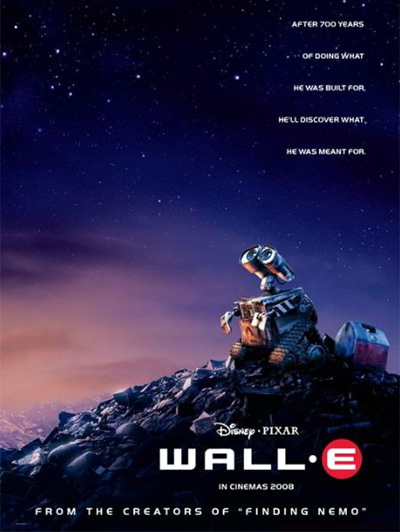
WALL-E (2008)

I've never been so emotionally invested in a robot.

WALL-E is a well-thought-out story of a lone robot trying to compact all of Earth's garbage while humans drift through space waiting for their home to become livable again. Andrew Stanton, with some assistance from the Grand Master of Sound, Ben Burtt, has given us characters that can win you over without saying a word. There are plenty of other elements to laud this film for - improved camera work over past Pixar productions, original concepts, biting socio-environmental commentary, more nods at other films than at which you can shake a fish... But the true, achievement of this film is how easily you can engage with it.

It's not that this film is perfect. It has it's share of plot holes/logical fallacies, but, unlike so many other films, I didn't feel the need to think about them until after the movie was over. And yes, there's some rather drawn out moments in the second act. But the powerful story of a creature looking for companionship overwhelms the flaws. Even when WALL-E takes more beatings than you'd like to see, it's a testament to the reason you don't want to see him get hurt: you like him. He's the deepest animated character possibly ever and for that, I can forgive him for looking a lot like the horrid No. 5 from Short Circuit.

Rating: 5/5
Recommended for: Everyone everywhere.

Extended review: I first have to mention WALL-E's beat up VHS of Hello, Dolly. It's the only complete dialogue in the first 30 minutes. Even though it's a film I don't really enjoy, I like it here. The two numbers selected fit harmoniously with WALL-E's aspirations - in a way giving him an extra voice. In a way it was a bold choice, but it paid off.

The other "character" meriting a more in-depth mention is/are the humans. Or, to put it more precisely, the large, lazy, floating tubs of lard. On Earth, WALL-E comes across an old billboard ad for The Axiom and it highlights that even grandma can come along on this ship because of the floating chair technology. Once aboard The Axiom you see everyone uses the chairs due to bone-loss from being in space so long and sheer laziness. It's elements like that which show how well-thought-out and detail-oriented the people behind this film are. And that's definitely appreciated.

July 5, 2008

Bonnie and Clyde (1967)

One morning Bonnie Parker, played by Faye Dunaway, catches Warren Beatty's Clyde Barrow trying to steal her family's car. The way they play it, you'd think this was a daily occurrence. It's not though, and Bonnie's spur-of-the-moment decision to run around with Clyde for the day turns into a lifestyle.

A hitch in the flow of this free-wheeling film is the score - and sometime lack of it. There are moments where it feels like something is missing and that's when you'll notice the silence. The music that does exist, often feels (for lack of a better term) a bit too hillbilly - even for a film set in the south. The resulting corniness makes you expect those sequences to be played in double time for added comedic effect in an otherwise serious story.

Dunaway's Bonnie is a desperate escapist who doesn't shirk from the idea of becoming a criminal. In fact, no one in the Barrow gang seems to even think twice about it, even though half of them are sucked in at the spur of the moment. This is perhaps the most intriguing element of the film. Even Clyde's incredibly annoying banshee of a sister-in-law never actively finds a means of escaping the Mr. Toad's Wild Ride of an adventure even though she clearly doesn't enjoy it.

This is the first film to portray a shooter and a person getting shot in the same frame. The results are pretty gruesome especially in contrast to the rest of the movie. The juxtaposition of a whimsical couple having fun with the serious crimes, incidents, and injuries puts a harsh but needed perspective on a time where bank robbers were glamorized.

Rating:4/5
Recommended for: Anyone over the age of 12 who doesn't mind a little fun before being brought back down to Earth.

Extended review: The film's end shows how so many infamous criminals of that era met their end: being too cocky. Criminals like Bonnie and Clyde were treated like movie stars. They'd introduce themselves during their crimes, make visits to their families, and wave to people in the streets - never thinking that any of these people would dare turn them in. Mrs. Parker's warning that they better keep running is brushed off almost as a joke. To the audience, C.W.'s father's arrangement with the police is understandable. But the Barrow gang doesn't think of it even as a possibility. The sudden demise of Bonnie and Clyde brings their reign and the film to an abrupt end. The audience is left alone with their thoughts; you feel bad for them because they never saw it coming, yet you're reminded that they these two were the bad guys in the first place. It's an interesting balance.

March 2, 2008

The Queen (2006)

Fact and supposed fact are blended seamlessly in Stephen Frear's The Queen. Set in the days after Princess Diana's death in 1997, this film tells the story of what most likely happened to bring HRM Queen Elizabeth II from frigid silence to public mourning.

Helen Mirren earned her Oscar by not only presenting an impeccable visual replication of the Queen, but bringing a real understanding of this woman who sits so high atop her throne. Especially interesting is Michael Sheen in Prime Minister Tony Blair's role and his efforts in the queen's decision to go public. Beautifully filmed and realistically portrayed, this is a compelling story, even though you know how it ends.

Rating: 5/5
Recommended for: Everyone (except maybe small children who won't have the attention span/memories of Princess Diana)

Extended Review: Peter Morgan, who wrote the script, was able to interview several government insiders and structure a likely story of what happened behind closed doors during this time. Between that, using actual news footage, and the use of lighting in the filmed part, the filmmakers really blur the lines and make you feel as if you've been granted special access to see the events unfold.

February 28, 2008

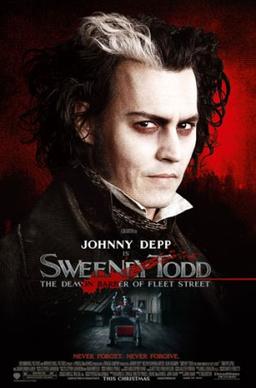
Sweeney Todd (2007)

This film could also have been titled There Will Be Blood.

Sweeney Todd stars the irrevocable chameleon Johnny Depp as a barber seeking revenge for having his family stolen by the nefarious Judge Turpin (played with wicked glee as always by Alan Rickman). Based on the stage musical by Steven Sondheim, this gritty rendition directed by Tim Burton is not for the faint hearted, lacking most of the cheesiness that can come with a musical and possessing much more blood-loss.

Dark sets project the dank, old London with black, white, and shades of gray reigning so supreme, the red blood stands out even more. Helena Bonham Carter co-stars as Todd's accomplice, Mrs. Lovett, and while she doesn't have the strongest singing voice, the easy camaraderie between her and Depp makes up for it. Memorable appearances are made by Sascha Baron Cohen, as rival barber Pirelli, Ed Sanders, as workhouse orphan Toby, and Jamie Campbell Bower as a sailor named Anthoy Hope whose gentle performance of "Johanna" will be floating through your head for days. Even with great music and a compelling story, it is not appropriate for small children.

Rating: 4/5
Recommended for: Anyone who likes a gripping tale of revenge (or Johnny Depp) and doesn't mind the sight of blood.


Extended review: It becomes so easy to get used to the dismal grays of the atmosphere, that when Mrs. Lovett fantasizes during "By the Sea", the sudden shock of a blue sky actually made me gasp out loud. It contains the film's silliest moments, but audiences might find the sequence a bit of respite in the midst of Todd's bloodier and bloodier descent into revenge. It may only be Lovett's imaginary world, but even in her dreams, she sees there's only one thing on Todd's mind.

December 16, 2007

Year of the Dog (2007)

Year of the Dog is a 97-minute punch to the gut. Molly Shannon stars as Peggy, a lonely secretary whose dog dies within the first ten minutes of the film. The dog's death sets in motion a whole out-of-control shift in Peggy's life. Without ruining too much, the events that follow include veganism, abused animals, rejected love, and forcing opinions on small children. Things get pushed to the extreme and it's not pretty. This is not the light-hearted movie that it may appear to be.
The movie also stars Peter Sarsgasrd as a sympathetic staff member of Peggy's vet, John C. Reilly as Peggy's hunting-loving neighbor, and Laura Dern as Peggy's ultra-controlling sister-in-law.

Rating: 2/5
Recommended for:People who need a good cry/kick in the gut.

Extended Review: The movie went to extremes. Every actor comes across as fully committed to their character. It's just difficult to watch someone's life get taken over by an idea and be willing to sacrifice every human relationship they have. You expect it to be funny because of Molly Shannon's reputation, but there will be few if any moments of laughter.

November 23, 2007

License to Wed (2007)


We see it's not such a good idea to stop communicating with someone you plan on marrying in this rather formulated romantic comedy. John Krasinski plays Ben, who - in the first ten minutes of the film - embarrasses himself in front of, meets, dates, embarrasses himself some more in front of, and gets engaged to Sadie, played by Mandy Moore.

After Ben proposes, they apparently have 5 seconds in which to decide where they will get married. Ben wants to have a destination wedding while Sadie wants to get married in a church she hasn't even attended in 10 years, but alas, it's part of her typical wedding plan concocted in childhood. From there on, Sadie's not a team player and thus it's harder and harder for Moore to make her sympathetic.

To top it off, the church requires a pre-wedding course run by the incredibly creepy Rev. Frank, played by Robin Williams. Not-so-hilarious antics ensue as they go through Frank's tests - the most creepy and disturbing of all involving robotic twin babies.

The movie becomes increasingly uncomfortable and brushes against the point where you just want to shut off the movie. The ending's predictable, but if you like to know where your movie is going at all times and like only like to be surprised by new heights of corny line delivery, it'll be just right. Bottom line: Kransinski manages to hold his own. Williams stretches his creepy muscles. And it's nice to see cast member from The Office outside of The Office.

Rating: 2/5
Recommended for: Fans of predictable romantic comedy and adults who haven't realized it's pretty important to communicate with your significant other.

Extended Review: Rev. Frank's sidekick minister-in-training seriously gives the best line deliveries and may very well be the best part of the movie. The kid totally commits to the character/performance. Meanwhile you can't tell if his mentor, Rev. Frank, wants to see Sadie & Ben fail, just enjoys watching people fail, or seriously wants to prepare them but just is incredibly socially awkward. Sadly the film does venture into reality in some of its couples' behavior. There are also plenty of bridezillas out there who've had a dream wedding planned all her life and she's not about to let anything or anyone (like the person she's marrying) get in her way. More of the film's uncomfortableness comes from the fact that Mandy Moore plays this role. She's normally so darn likeable and in those few cases she's not supposed to be, you even like to not like her. Here, you don't really like her, but you don't like that you don't like her. Sort of like this film.

November 17, 2007

Notorious (1946)

Alfred Hitchcock directs Ingrid Bergman, Cary Grant, and Claude Rains in this 1946 film-noir thriller. Good news for the squeamish and jumpy: There are no birds pecking anyone, no one being attacked in a shower, no one almost gets mowed down by a plane, and it won't make you dizzy.

Bergman is Alicia, the daughter of a former Nazi, asked by US agent T.R. Devlin (Cary Grant) to spy on some of her father's former friends in Brazil. She leads a willy-nilly life and harbors a bit of guilt over her father's actions, so she drops everything and goes with it. It just so happens that the leader of these "friends", Alexander Sebastian, was once in love with Alicia, so it's pretty easy for her to slip into their group and the next thing she (and the audience) knows he's asking her to marry him. Continuing with her "oh what the heck" attitude, she goes with that too. Alexander's mother suspects something's strange about Alicia that moment she walks in and eventually Alexander comes to be of that opinion too.

So what does a man with a shady past and present do when he figures out he's married to a spy? It's where the movie really gets interesting and the audience feels any investment in the characters start to mature. Alicia definitely isn't the gun-toting, rip-line-using, bustier-wearing Mrs. Smith of the 2005 Jolie-Pitt spy flick. She's in over her head with absolutely no training. Her only back-up is Devlin, who can't tell if she's taking the mission seriously or not and isn't sure if he can get her out before it's too late.

On the other team, we have the elderly Mrs. Sebastian who seems to be just waiting for a chance to put cruel words to actions, and her son, who has the wealth and network to do almost whatever he wants. Even though there's clearly a limited window for everyone involved, the film's pacing doesn't seem to speed up at all which serves to double the tension and make the conclusion all the more dramatic.

Rating: 4/5
Recommended for: Everyone over age 12, even if you don't usually like Hitchcock films

Extended review: Ok. I'll concede this: sending someone on a mission as a spy with no training and no exit plan doesn't seem that realistic. Perhaps that way they thought Alicia would seem more natural/less suspicious? Devlin does a good job of sliding into the scene next to her as an old friend but she meets with him so often right in broad daylight of course it eventually makes people wonder. It's probably why I didn't find myself that involved in the film until she's figured out. As Alicia slowly dies, you think Devlin will figure it out and save the day, but instead, in a moment of great irony, Alicia's well-known drinking habit is what stops Devlin from really checking in to why she seems a bit off. When Devlin finally comes to check on her the slow rescue right in front of the bad guys still infuses a little doubt that she'll be saved. Hitchcock has done something great here with expectations. You expect sneaking and running and you get slowly stepping and eye-to-eye confrontation. Questions of Devlin's aptitude are put to rest when he finally manages not only to save her, but stick Alexander in a no-win situation that'll prove to be his undoing. Cary Grant pulls it off so suavely that you may think he's not such a poor agent after all.

November 1, 2007

Pittsburgh (2006)

Jeff Goldblum stars in this 2006 mockumentary of sorts of a Pittsburgh production of The Music Man. I say mockumentary of sorts because it's treated like a documentary, yet not taken as seriously as real one, and yet isn't funny and silly like a standard mockumentary.

In the movie, Goldblum plays himself - although it's not clear if the character is really him or a stereotype of him created by the roles for which he's known. He goes back to his hometown of Pittsburgh to star in a regional production of The Music Man because his actress fiancee needs a visa to stay in the country. It's a promising premise but it falls out of focus. Side stories of Goldblum's friends, Illeana Douglas and Ed Begley Jr., jump in from time to time. Goldblum's convinced them to join the show too, but we see a lot more of their non-acting life, than their work in the show - which may leave the viewer wondering why the other actors are there. Additionally, Goldblum's "creative differences" with the show's director make you more worried about the poor people paying to see the show than laughing at their exchanges.

Rating: 1/5
Recommended for: People who'd watch Jeff Goldblum in anything or would like to relive being in a production of The Music Man


Extended Review: I usually enjoy Jeff Goldblum. His roles in Jurassic Park and Life Aquatic are thoroughly enjoyable. The problem is Goldblum's Harold Hill is Dr. Ian Malcom with a bit more caffiene in his system. Harold Hill is a fly-by-the-seat of his pants wheeler and dealer, not droll, agitated, and squirmy. The difference between this and the comedy of a Christopher Guest mockumentary is the Guest characters usually think they're doing a great job and just go with the flow. The more trouble Goldblum has with the show, the more he wants to distance himself from it and even goes as far as telling a hotel staff member that the show probably won't go well on opening night. That may be real, but it's not funny.

Alice Adams (1935)

Katharine Hepburn stars in this 1935 film about a family divided by social aspirations. Father, Virgil, and son, Walter, are complacent with their middle-class status while daughter, Alice, quietly yearns to have the life of her richer friends, and her mother is quite vocal about Alice deserving those "better" things.

Despite a history of being snubbed due to her socio-economic status, Alice manages to attract the attention of the well-to-do Arthur Russell. Alice's mother is determined to impress Arthur to make sure he doesn't run away - even if it means pushing the family past the brink of patience. Hepburn shines in this role and practically floats through the film. It's almost hard to believe any man would walk past her without looking. Despite the strong materialism and fixed gender roles, it's rather easy to have sympathy for Alice; she's trying so hard to be liked. And despite all her efforts, everything hinges around a dinner that leaves everyone sweating - figuratively and literally.

Rating:3.5/5
Recommended for: People ages 18 and up - not because of anything obscene... it just might bore younglings.

Extended Review: The dinner scene makes the film. You know going into it that it won't go that well. Yet as one thing goes wrong on top of another, each makes you cringe a little more. Alice sees it all too and walks the thin line of trying to save the day, and thus the relationship with Arthur, and giving in all together. Because of the time period, it's pretty hard to tell if Arthur's being silent to let her speak or if he really appreciates the out being handed to him. You find out soon enough though.
Nothing special to report on the cinematography. Additionally, the black and white film itself left me wanting more. I felt like the differences between the Adams and the other families cold have really been highlighted with color. Of course, at that time it wasn't really an option and the film succeeds in still physically illustrating the difference.
Disclaimer: Low-resolution, scaled-down images of movie posters are used in this blog to provide critical commentary on the film, event, etc. in question or of the poster itself, not solely for illustration. This is believed to qualify as fair use under United States copyright law. The copyright for the posters are most likely owned by either the publisher or the creator of the work depicted. As a film poster, the image is not replaceable by any known free content; any other image that shows the images from the movie poster would also be copyrighted, and any version that is not true to the original would be inadequate for identification or commentary.